⭐ 4.9/5 · 143 Google Reviews — Nail sickness is the defining roofing problem across Leicester's post-war housing estates. Braunstone, Eyres Monsell, Thurmaston and Birstall were built in the 1940s–60s with concrete interlocking tile fixed with steel nails that are now corroding at scale. Tiles that appear sound from the ground are sitting unfixed on the battens — ready to displace in the next wind event.
Tell us the job in 30 seconds. No pushy sales, no call-out fee.
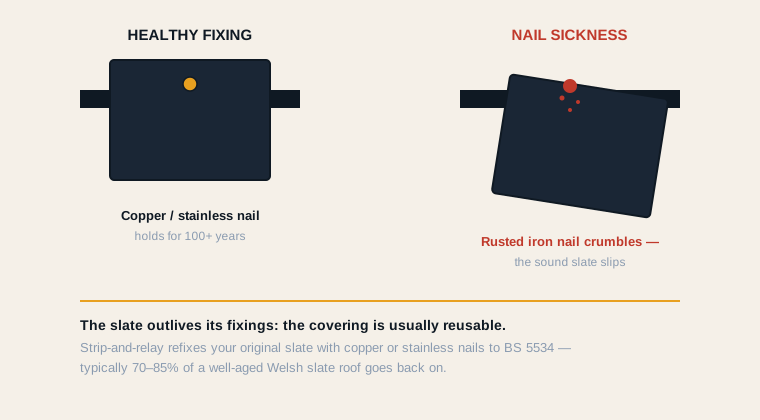
📞 Call Now: 0116 319 1348Concrete interlocking tiles installed on Leicester post-war estates in the 1940s–1960s were fixed with ferrous (iron or mild steel) nails. The galvanised coating on these nails has a design life of approximately 40–60 years. On the oldest Braunstone estate properties, that design life expired in the 1990s. On the 1960s Eyres Monsell and Thurmaston stock, it is expiring now. As the galvanising fails, the underlying steel corrodes and expands, eventually snapping or becoming so degraded that the tile fixing is lost entirely. The tile then rests on the batten with nothing holding it — a strong wind event can lift and displace multiple tiles simultaneously.
Proactive re-nailing on a standard Leicester post-war semi costs £600–£1,200. Emergency call-out after tile displacement in a storm event, plus tile replacement, plus temporary protection, plus the same re-nailing work that should have been done proactively, costs £1,500–£3,000 on the same property. The economic case for proactive re-nailing is straightforward. We survey for nail sickness across all Leicester post-war estate areas and advise on the urgency of each property's specific condition.
Ground-level survey using binoculars identifies tiles that have slipped or are misaligned — the most visible sign of advanced nail sickness. Loft inspection confirms the state of the fixings visible from inside. Where re-nailing is appropriate, we lift each tile individually, inspect the nail condition, and re-fix with A4 stainless steel nails that will outlast the property. No tile is relaid without a sound stainless fixing. We do not re-use corroded nails or use aluminium nails as a budget alternative.
On properties where tile sickness is advanced and the tiles themselves have surface degradation, frost spalling, or pattern cracking, re-nailing alone may not be the most economic approach. If the tiles need replacement as well as the fixings, a full re-roof may deliver better value over a 20-year horizon than re-nailing followed by tile replacement within 10 years. We give an honest assessment on the survey — re-nailing is appropriate on the majority of Leicester post-war properties; full re-roofing is appropriate on a minority where tile condition is poor.
The highest concentration of nail sickness in our coverage area is in the 1940s–50s Braunstone estate where the oldest housing stock has the most advanced corrosion. Eyres Monsell (1960s) is reaching critical stage now. Thurmaston and Birstall (1960s–70s) are progressing. We estimate 60–70% of post-war concrete tile properties in these areas have nail sickness in some stage of progression. Properties on exposed streets with west or south-west facing slopes show earlier onset than sheltered north-east facing properties on the same estate.
“Nail sickness survey carried out on our Braunstone semi. Report confirmed two slopes at critical stage. Re-nailed with stainless throughout before any tiles displaced. Exactly the right approach.”
“After a windy night we had three tiles down. Surveyed and found nail sickness throughout. Full re-nail done in two days. Should have done it years ago.”
“Emergency call after tiles displaced in storm. Made safe same day, re-nailed the following week. Written report provided for insurance. Efficient and honest throughout.”
From the ground, look for tiles that are sitting slightly lower than their neighbours, tiles with a visible gap at the head, or tiles that have slipped down the slope. In a loft inspection, corroded nails are visible as rust-stained wood around the nail holes in the battens. The definitive assessment is from a free survey — we inspect from ground level and loft level and confirm the extent and urgency of nail sickness across your specific property.
Re-nailing a standard 3-bed Leicester semi typically takes 1–2 days. The work involves lifting each tile, inspecting and replacing the fixing, and relaying. No scaffold is required for most standard post-war semi-detached properties — extending ladder or access tower provides safe access to all standard roof heights.
A4 grade stainless steel roofing nails. These are the highest corrosion-resistance specification available — A4 stainless has no practical corrosion design life limit in a UK roofing environment. We do not use aluminium nails (adequate but not optimal) or galvanised nails (same failure mode as the original fixings but with a shorter remaining life).
Yes, potentially. If a tile displaces and causes damage after you have been made aware of nail sickness and taken no action, an insurer may argue that the damage was foreseeable and therefore not covered as sudden storm damage. A documented proactive re-nailing programme protects your position. We provide a written survey report and completion certificate that can be provided to your insurer.
Partially. Temporary clips or hooks can hold individual displaced tiles after a storm event. These are emergency measures, not long-term solutions. Clips hold individual tiles but do not address the systematic fixing failure across the whole roof. Re-nailing is the only permanent solution to nail sickness.
Re-nailing a single slope on a standard Leicester semi costs £300–£600 depending on roof area. Full re-nailing of all slopes on a 3-bed semi: £800–£1,400. Full re-nailing on a 4-bed detached: £1,200–£2,000. All prices confirmed in writing after survey. We quote per slope so you can address the most urgent elevations first if budget requires a phased approach.
The repair of nail sickness itself — re-nailing as a preventative maintenance measure — is not covered by standard home insurance. It is a maintenance item. Damage caused by a tile that displaces due to nail sickness in a storm event may be covered as storm damage, but insurers are increasingly scrutinising claims where the underlying condition was known or should have been known. Proactive maintenance is the correct approach.
Braunstone is the most affected estate in our coverage area — 1940s–50s housing with the oldest concrete tile and original fixings. Eyres Monsell (1960s) is now reaching critical stage. Thurmaston, Birstall and parts of Wigston (1960s–70s) are progressing. New Parks (1930s–50s) also has significant nail sickness on the older streets. We carry out free nail sickness surveys across all these areas — call 0116 319 1348 to book.
No call-out fees. No obligation. Written quote within 48 hours. Covering all of Leicester and Leicestershire.
0116 319 1348 ✉ Email Us