⭐ 4.9/5 · 143 Reviews — How to tell whether damp in your Leicester rental is coming from the roof, the common culprits by housing type, and why acting fast is now a compliance issue.
Roof-sourced damp shows as a defined patch on a ceiling or high wall, often worse after rain — distinct from diffuse condensation on cold surfaces. Failed valleys, flashings, slipped tiles and blocked gutters are common Leicester culprits. As damp and mould lead Awaab's Law, landlords should rule out roof causes fast. Call 0116 319 1348.
Honest advice
Do You Actually Need Roof Repairs?
Most Leicester roof problems announce themselves the same way — a damp patch, a dropped tile, or debris in the garden after wind. Here is how to tell a repair from something bigger.
A damp patch or brown staining on an upstairs ceiling after rain
One or more slipped, cracked or missing tiles visible from the ground
Debris — tile fragments or mortar — in the garden after high wind
Daylight visible through the roof from inside the loft
A single lifted ridge tile or a run of loose ridge mortar
When it is not the answer: If more than about a third of the covering has failed, or the fixing nails across a whole slope are corroding, repairing tile-by-tile is money wasted Read the full guide.
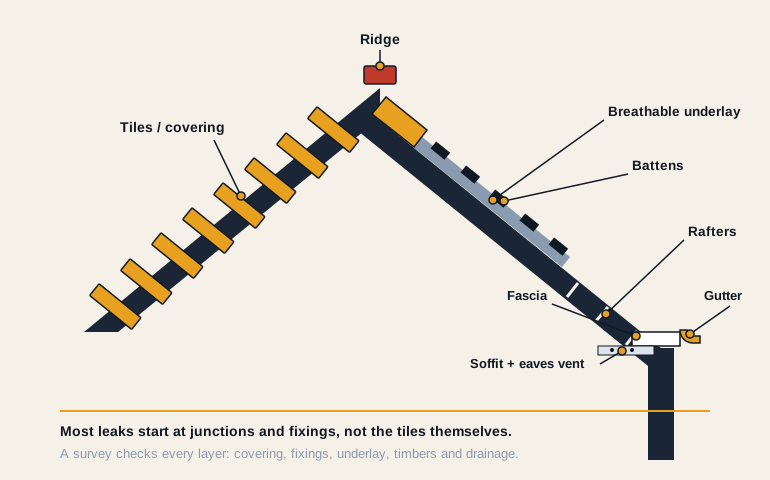
The anatomy of a typical pitched roof — the elements a repair survey checks.The process
What to Expect: Roof Repairs in Leicester
1. Free survey
We inspect the roof from ground and loft, and by drone where close access helps, to pin down the exact fault — not just the symptom.
2. Written itemised quote
You get a fixed written price within 48 hours, each element listed separately so you can see what you are paying for.
3. Scheduling
Most repairs are booked within one to two weeks; genuine emergencies are same-day.
4. The repair
We carry out the work, matching tiles and using correct lead and lime mortar on period stock.
5. Cleanup & sign-off
We clear all debris, leave the site tidy, and hand over the written workmanship guarantee.
Wet or high-wind days pause tiling and lead work — we build weather margin into every booking so a forecast does not leave your roof open.
Access
Access, Scaffolding & Permits in Leicester
Most Leicester repairs run from a tower or roof ladder; scaffold is quoted only where the job needs safe standing time at height. Scaffold is specified for: chimney-side repairs, full valley rebuilds, three-storey terraces, and anything beyond a day at height - always itemised in your written quote, never a hidden extra, and we arrange it.
Victorian terraces in Highfields and Belgrave mean rear-access scaffold and permit-controlled pavement space; the open post-war estates at Braunstone and Thurmaston are more straightforward to scaffold. Pavement scaffold and skip permits go through Leicester City Council; allow a few working days on streets like East Park Road, Narborough Road, the terraced streets off London Road where space is tight.
Pricing
Roof Repairs Prices in Leicester
Job
Typical range
Notes
Slipped or cracked tiles
£150–£400
Per visit, incl. access
Chimney flashing repair
£200–£600
Depends on flashing run
Single lead valley re-run
£400–£700
Code 4–5 milled lead
Full ridge & hip re-bed
£500–£900
Or dry-fix upgrade
Slope re-nail (nail sickness)
£300–£1,400
Single slope to full
What moves the price
Roof height and whether scaffold is needed
How many tiles or how much lead is affected
Matching tiles or lead on period stock
Ease of access on terraced streets
Whether timbers below are sound
Worked example: A 1930s semi in Wigston — three cracked tiles replaced, the front ridge re-bedded and a chimney apron flashing renewed — typically £550–£750, done in a day from tower access.
No deposit on repairs under £500. Larger repairs are paid on completion, nothing up front before materials are on site.
Covering LE1, LE2, LE3, LE4, LE5 and surrounding postcodes.
Guarantee
Your Guarantee, Explained
Workmanship on the repaired section is covered for 10 years in writing; any replacement tiles and lead carry their manufacturer warranties on top.
Covered: workmanship for 10 years, in writing, transferable if you sell.
On top: manufacturer warranties on materials (terms vary by product).
Not covered: storm or impact damage - that is an insurance matter, and we will document it for your claim.
If a fault appears in covered work, we come back and put it right. No quibbling, no re-charge.
Good to know
What It Is Like While We Work
A day of ladder or tower work and a small amount of tile debris — we sheet below the work area and clear everything before we leave. You do not need to stay home for external work - we just need power and access agreed in advance.
Repairs run year-round; temporary weatherproofing goes on the same day if rain stops work mid-job. Leicester’s inland Midlands position means wind-driven rain is the main roofing stress rather than coastal salt.
The distinction
Roof Damp or Condensation? How to Tell
Before spending a penny, it is worth knowing which problem you actually have, because the fixes are completely different. Roof-sourced damp and lifestyle condensation look superficially similar — both leave damp walls and mould — but they behave differently.
Signs it is the roof: a defined damp patch, often on a ceiling or high on a wall directly below the roof or a valley; staining that worsens noticeably during and after rain; sometimes a brown tide-mark at the edge of the patch; and a location that lines up with a roof feature (below a chimney, a valley, or a flat-roof junction).
Signs it is condensation: diffuse damp on cold surfaces — window reveals, external-wall corners, behind wardrobes; worse in winter and in humid, poorly-ventilated rooms like bathrooms and kitchens; tracks with how the home is heated and ventilated rather than with rainfall; and typically no single defined source.
A quick roof inspection settles it either way. If the roof and roofline are sound and dry, attention turns to ventilation and heating; if we find an ingress point, that is your culprit.
The Homes (Fitness for Human Habitation) Act 2018 makes a property potentially unfit where damp and mould are serious enough to affect the tenant's health, giving tenants a direct route to enforce repair. Source: Homes (Fitness for Human Habitation) Act 2018
Leicester stock
Common Roof Causes of Damp by Leicester Housing Type
Leicester's housing eras each have signature routes for water to get in:
Victorian terraces (Highfields, Belgrave, Clarendon Park): century-old lead valleys fatigue and crack, and original underfelt perishes, letting wind-driven rain bypass the tiles into the back-addition ceilings. Damp on a top-floor rear ceiling of a terrace is very often a valley problem.
1930s semis (Oadby, Evington, West Knighton): failed ridge mortar and ageing flat-roof extension detailing are common. Damp at the junction between the main roof and a flat-roofed rear extension is a classic here.
Post-war estates (Braunstone, Thurmaston, New Parks): nail sickness opens gaps between slipping concrete tiles, and wind-driven rain finds them. Damp across an upstairs ceiling on an estate semi frequently traces to this.
All types: blocked or overflowing gutters push water back against the wall at the eaves, causing damp at the top of upstairs walls regardless of the roof covering. It is one of the cheapest causes to fix and one of the most overlooked.
Compliance
Why Speed Matters More Than It Used To
Damp and mould are not just a maintenance nuisance any more — they are the leading edge of housing-condition enforcement. They were the first hazards Awaab's Law addressed in social housing from October 2025, and they are expected to be first in scope when Awaab's Law extends to private lets under the Renters' Rights Act 2025 (no confirmed date yet, but the direction is clear). Combined with the Homes (Fitness) Act already in force, this means a Leicester landlord who leaves reported mould unaddressed is exposed on multiple fronts.
The practical takeaway: when a tenant reports damp or mould, rule out or fix any roof cause quickly, and document it. Our landlord roofing service includes diagnostic inspections and the photographic records you need. If the roof is the source, we stop the ingress; if it is not, you have saved the cost of unnecessary roof work and can address ventilation instead. See also our obligations guide and roof inspection service.
FAQ
Frequently Asked Questions
Roof-sourced damp usually shows as a defined patch on a ceiling or high on a wall, often worse after rain, sometimes with a tide-mark. Condensation is more diffuse, appears on cold surfaces and in poorly-ventilated rooms (bathrooms, behind furniture), and tracks with humidity rather than rainfall. A roof inspection can confirm or rule out roof ingress quickly.
Yes. A failed valley, cracked flashing, slipped tiles or blocked gutters can let water into a wall or ceiling void, where it feeds mould growth that surfaces in the room. Because damp and mould are the first hazards covered by Awaab's Law in social housing — and are heading for the private sector — landlords have strong reason to rule out roof causes fast.
Where mould results from a disrepair the landlord is responsible for — such as a roof leak or failed guttering — yes, remedying it is the landlord's duty under section 11 and the Homes (Fitness) Act 2018. Where mould is purely from tenant lifestyle condensation with adequate ventilation provided, responsibility is more shared, but landlords are still expected to provide a home capable of being kept free of serious damp.
On Victorian terraces, fatigued lead valleys and perished underfelt; on 1930s semis, failed ridge and flat-roof-extension detailing; on post-war estates, nail-sickness gaps letting wind-driven rain in. Blocked or overflowing gutters cause damp at the eaves across all stock types.
Promptly — and once Awaab's Law extends to private lets, within fixed statutory timescales expected to mirror social housing (short windows to investigate and act on damp and mould). Even now, a slow response risks a Homes (Fitness) Act claim and council enforcement, so treating reported mould as a priority is both compliant and sensible.
Yes. We inspect the roof, roofline and flashings for ingress points and document our findings with photographs, so you know whether the cause is roofing or something else (like condensation or rising damp) before spending money. This targeted diagnosis avoids paying to "fix" a roof that was never the problem.
No. Painting over or wiping mould without addressing a roof leak feeding it is a temporary cosmetic fix — the mould returns because the water source remains. The durable answer is to stop the ingress at the roof, dry the structure, then treat the residual mould.
Landlord Roof Support
Roof Problem at a Leicester Rental?
Priority response for tenanted properties, itemised invoices for your records, and coordination with your tenant or agent.