Why Guttering Size Matters
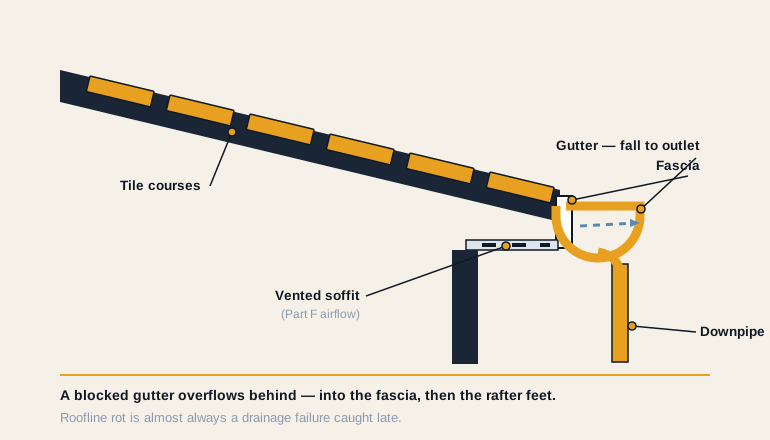
Guttering works by collecting roof runoff at the eaves and directing it to the downpipe. The capacity of the gutter — determined by its cross-sectional profile size — needs to match the volume of water that flows off the roof area it serves during peak rainfall. If the gutter is undersized for its roof area, it will overflow during heavy rain regardless of whether it's clean and correctly fall-graded. No amount of maintenance resolves an undersized gutter.
Standard domestic uPVC guttering in the UK comes in several sizes and profiles. Understanding which is appropriate for a Leicester property depends on the roof area, the pitch, and whether the gutter is in a high-flow position (a valley outlet, for example, collects water from two slopes simultaneously and needs more capacity than a standard eaves gutter).
Gutter capacity must match the effective roof area drained to it to handle peak rainfall intensity without overflow. Source: BS EN 12056-3 (Roof drainage design)
The Main Guttering Profiles
Half-Round Guttering
Half-round is the standard profile for domestic residential property in Leicester. The 112mm half-round profile is the most common size and suits most standard semi-detached and terraced properties with a single gutter run. It was also the profile of original cast iron guttering on Victorian properties, which is why replacement uPVC on period properties typically uses half-round to match the original profile.
A 112mm half-round gutter with a 68mm downpipe can typically handle 35–40 litres per minute of flow, which is adequate for most Leicester semis on a standard front or rear elevation. Properties with unusually steep pitches (above 50°) or long gutter runs (above 12 metres) may benefit from 125mm or 150mm half-round.
Square (or Rectangular) Profile Guttering
Square profile guttering has a larger cross-section than half-round at the same nominal size and provides higher flow capacity per millimetre of nominal width. The 114mm square profile handles significantly more water than the 112mm half-round of equivalent nominal size. Square profile is typically used on larger properties, properties with high-flow conditions, or where the architect has specified a particular aesthetic.
On modern Leicester housing estate properties built in the 1990s onwards, square profile guttering is common as the original specification and should be replaced in kind.
Ogee (Victorian-Profile) Guttering
Ogee profile is a decorative S-curve profile that replicates the appearance of the traditional cast iron ogee guttering used on Victorian and Edwardian properties. For Leicester properties in Stoneygate, Clarendon Park and other period residential areas where the original cast iron ogee guttering is being replaced, uPVC ogee provides an appropriate visual match without the maintenance requirements of cast iron.
Ogee profile doesn't provide quite the same flow capacity as half-round at equivalent nominal sizes, but for standard residential applications on Leicester period properties it is adequate and visually correct.
How to Determine the Right Size for Your Leicester Property
The calculation involves three factors: effective roof area (length × width × a pitch factor); design rainfall intensity; and the capacity of the gutter profile at the design gradient. For most Leicester homeowners, the practical shortcut is:
- Standard 3-bed semi on a single elevation: 112mm half-round is correct in almost all cases.
- Large detached property with complex roof: 125mm or 150mm half-round, or 114mm square profile.
- Valley outlet position (collecting from two slopes): minimum 115mm square or 125mm half-round to handle the doubled flow.
- Victorian terrace with original cast iron: 112mm half-round or 114mm ogee as appropriate to match the original profile.
We specify the correct gutter size and profile on every survey — not all roofers do this, and incorrectly specified replacement guttering is a common cause of persistent overflow problems that the homeowner attributes to blockage rather than undersizing.
Downpipe Sizing
The downpipe is as important as the gutter — an adequately sized gutter connected to an undersized downpipe creates a bottleneck that causes the gutter to fill and overflow at the outlet point. Standard 68mm round downpipe is appropriate for most 112mm half-round guttering on a single elevation. Properties with longer gutter runs, valley outlet positions, or larger gutter profiles need 75mm or 110mm downpipe.
On Leicester Victorian terraces where the original cast iron downpipe was a large-section round or square profile, modern 68mm uPVC replacement is sometimes undersized for the gutter run it serves. We check the downpipe specification against the gutter run length and roof area on every guttering survey.
Gradient: the Most Common Installation Error
A gutter that is correctly sized but installed without adequate fall will pool water at low points and overflow at those points during heavy rain. The correct gradient is a minimum fall of 1:500 — approximately 6mm of fall per 3 metres of horizontal run — towards the downpipe outlet. A gutter that appears level from the ground is likely to have inadequate fall.
We set gutter gradient correctly on every installation using a spirit level and measured fall calculation rather than by eye. A gutter installed to correct gradient, in the correct profile and size, drains cleanly after every rainfall event and is unlikely to block except from direct leaf fall.
Specific Guidance for Common Leicester Property Types
Victorian terraces in Highfields, Belgrave and South Wigston present a specific guttering question: whether to replace like-for-like in cast iron or convert to uPVC. Cast iron half-round guttering on Victorian terraces, if maintained correctly — painted internally every 10 years — is superior to uPVC in durability and character. Unpainted cast iron corrodes from the inside and is typically at replacement age on Victorian Leicester terraces that haven't been maintained.
For Victorian terrace owners in Leicester who want to maintain period character, cast iron half-round uPVC in 112mm profile is visually equivalent and maintenance-free. For those who prefer actual cast iron, we can supply and fit cast iron half-round or ogee in the correct profile — it is more expensive than uPVC but appropriate for conservation area properties and adds character that uPVC cannot replicate.
When to Replace vs Repair Leicester Guttering
The decision between repair and replacement follows a straightforward framework. Single joint failures on otherwise sound guttering are worth repairing — the cost is modest and the rest of the gutter run is serviceable. Guttering with multiple failing joints across several sections, guttering that has lost its fall through bracket failure, and guttering that is undersized for its roof area are all better replaced in full.
On Leicester properties where the original guttering was installed in the 1990s uPVC replacement cycle, many installations are now 25–35 years old. Early uPVC degrades with UV exposure — the material becomes brittle, joints become difficult to seal, and replacement is more economic than continued patching. We assess guttering condition honestly on every survey visit and advise on repair, cleaning or replacement based on what we find rather than defaulting to the more expensive option.
Key Takeaways for Leicester Homeowners
The most important points from this article as they apply specifically to Leicester properties:
- Leicester's housing stock is unusually old — a higher proportion of Victorian and Edwardian properties than the national average means lead work, lime mortar and clay plain tile are day-to-day materials in Leicester roofing, not specialist categories.
- The post-war estate belt is at a maintenance transition point — Braunstone, Eyres Monsell, Birstall and Thurmaston have nail-sick concrete tile reaching critical stage simultaneously. Proactive action now costs significantly less than reactive emergency repair.
- Free surveys and written quotes are standard — any Leicester roofer who won't provide a free on-site survey and written itemised quote before work starts is not operating to professional standards. Don't accept verbal quotes or estimates given without a site visit.
- NFRC registration is verifiable in 30 seconds — check before you commit. It is the minimum credibility threshold for roofing work in Leicester.
We cover all of Leicester city and the surrounding Leicestershire area. Free surveys, written quotes, and no work starts without your written acceptance. Call 0116 319 1348 for a free survey across all Leicester postcodes.
Last reviewed: 20 July 2026